Beyond the Damage Photo: How AI Is Auditing Repair Costs in Motor Claims
Computer vision identifies the damage. That's only half the story. AI now validates whether the repair shop's estimate — and final invoice — actually match it. Here's how carriers are using automated estimate auditing to cut leakage without slowing settlements.
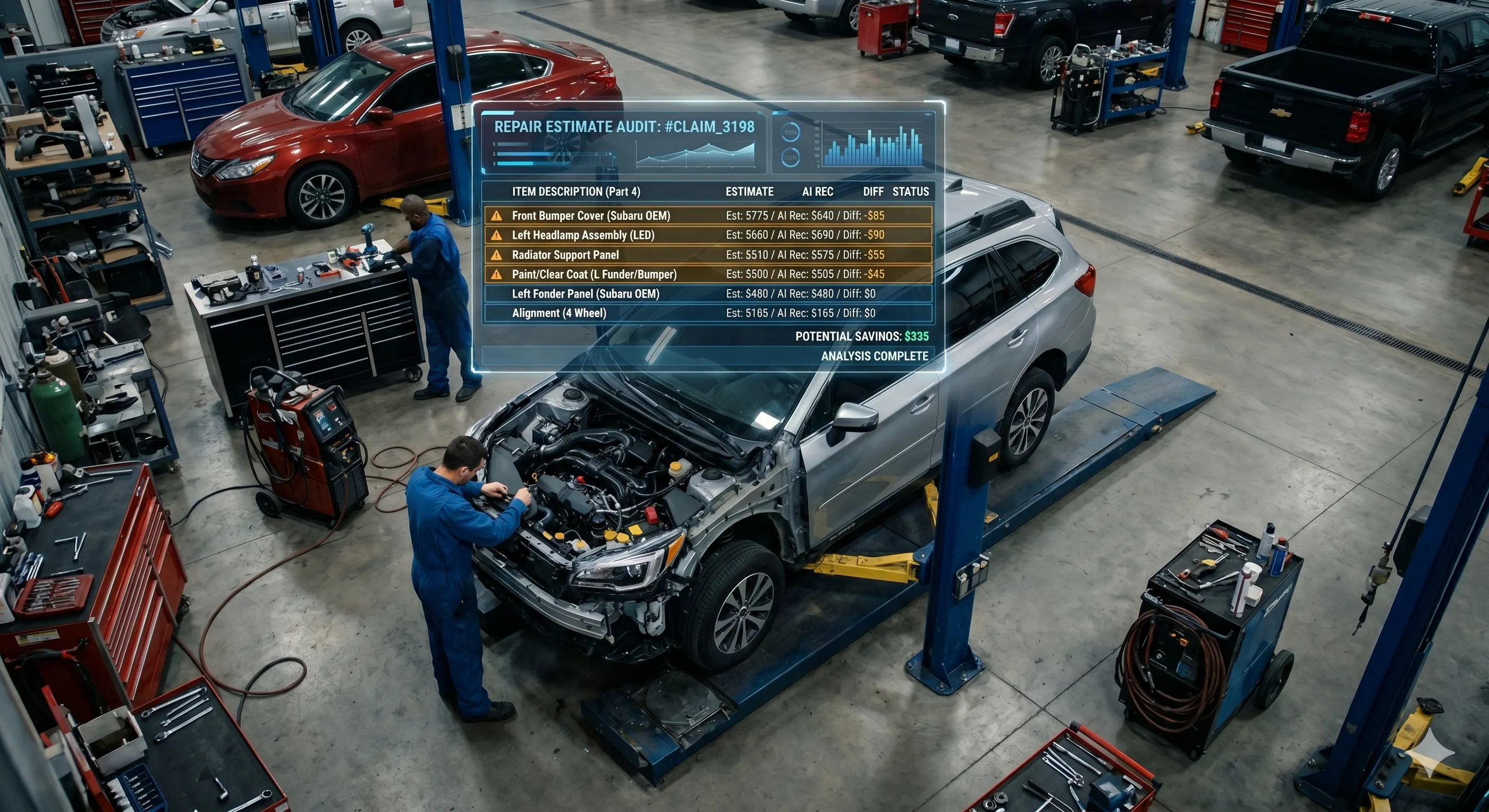
Accurate damage assessment and inflated repair invoices are two separate problems. Most published discussion of AI in motor claims focuses on the first. The second is where money quietly disappears.
Motor insurance loss ratios carry a persistent gap between what AI-assessed damage at FNOL suggests a repair will cost and what the final invoice from the body shop actually shows. That gap — part negotiated labor rates, part unnecessary work, part outright inflation — can run 10–20% on complex repairs. AI is now closing it.
How Automated Estimate Auditing Works
When a repair shop submits an estimate, AI systems cross-reference it against three independent layers:
- Original damage photos — Did the computer vision model at FNOL identify the parts listed for replacement? Are scope additions corroborated by photographic evidence?
- Parts and labor benchmarks — Are labor hours within expected ranges for the repair type? Are OEM parts charged where aftermarket or recycled are permissible under policy?
- Shop billing history — Does this shop's invoicing pattern deviate from peers for comparable damage profiles?
The output is a line-by-line audit flag, not a rejection. Examiners see exactly which items triggered a query and the evidence behind each flag.

Where the Leakage Comes From
Three patterns account for most estimate inflation:
- Scope creep — repairs added for damage not present in FNOL photos
- Labor hour inflation — especially on structural repairs where visual verification is harder
- Rental duration mismatch — repair timelines that don't align with the actual work scope
AI doesn't catch all of it. It does identify the most systematic patterns consistently and at volume — something manual review on a high-frequency book cannot sustain.

Settlement Speed Is Not Sacrificed
The concern with any audit layer is added delay. In practice, automated estimate review adds minutes, not days. Clean estimates — the majority — pass through without friction. Flagged estimates go to targeted examiner review, not a full re-examination.
The result is faster approvals on routine files and better-controlled costs on complex ones. Carriers using this approach report measurable improvement in repair cost per claim, independent of fraud. The arithmetic on a high-volume motor book is straightforward: AI checks every estimate, every time, at a consistency level no human team can replicate at scale.